BRAD DARKSON
Make Yourself Comfortable
II
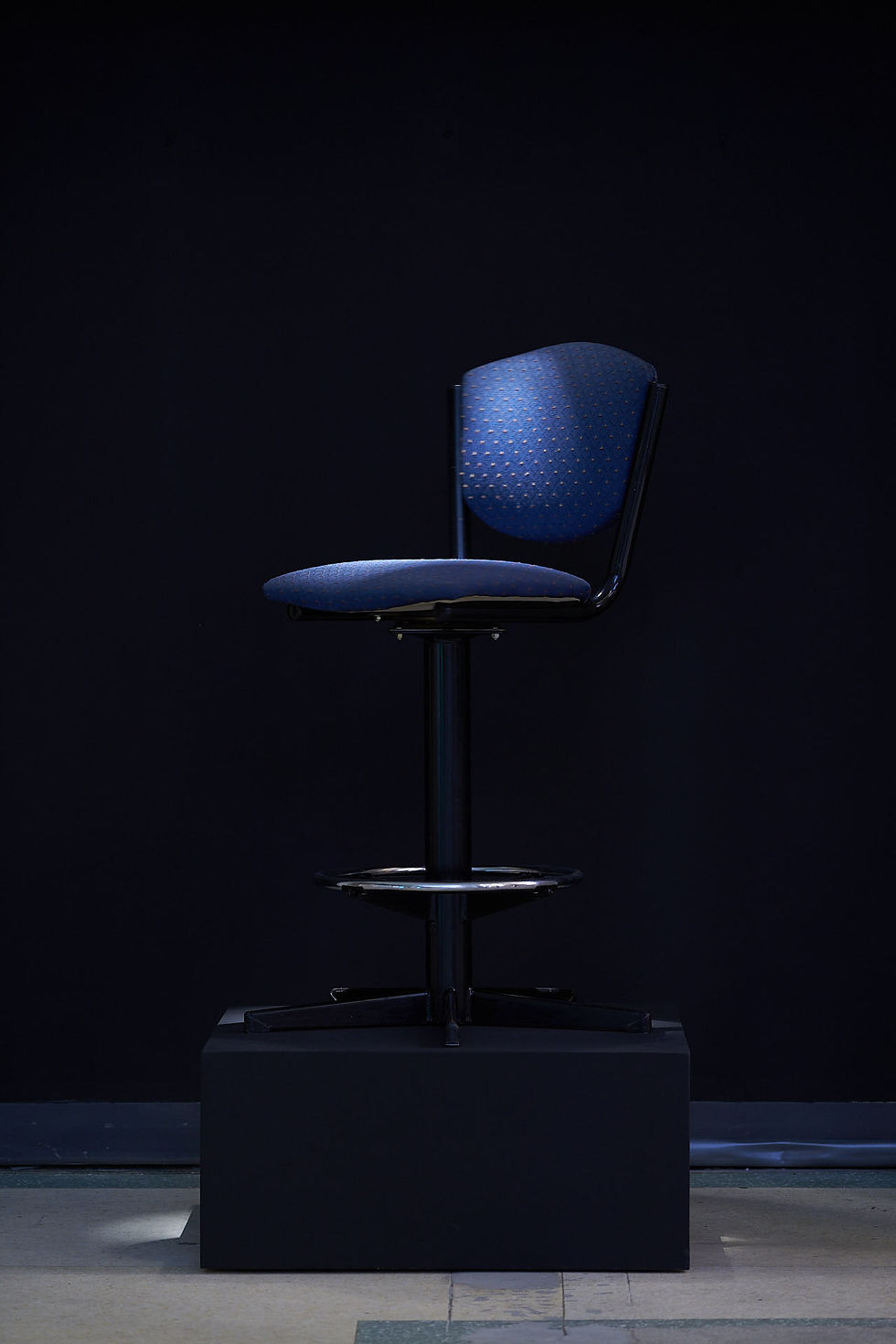
Aristocrat Leisure gaming lounge stool, plywood, acrylic paint, electric motor, 70 x 70 x 132 cm.


Photographs by Sam Roberts 2022
Curatorial rationale
Make Yourself Comfortable II
2022
Surely one of humankind’s greatest follies is the innate belief in our own autonomy. If we work hard, we can succeed. If we save money we can retire comfortably. If we diet and exercise, we can lose weight and become healthy. We are in charge of our own fate, and failure to capitalise on this is considered a moral failure. And yet, for all our autonomy, all of our technological advancements, much of our contemporary lifestyle, habits, work and environment is at odds with the design of our bodies and brains. While we know more about human behaviour and health than ever before, it is not always a linear journey to better outcomes for everyone. Look at addiction, for example. On one hand, understanding it means we can develop better tools to combat it. On the other, systems that benefit from addiction know how to hack into human biology to exploit it. In Brad Darkson’s work Make Yourself Comfortable II we are asked to consider the tension between human autonomy and the systems created to usurp it. They are innocuous, just like the chair Darkson presents us with, but its blandness belies the sinister forces at play. As white-collar desk jobs increased from the middle of the 20th Century,1 there is a corresponding rise in the popularity of ergonomics, which focuses on the efficiency of human and machine interactions.2 It is by now a familiar topic for most office or computer workers. But couched within the framework of efficiency and physical wellbeing, hides something more ominous. Consider this logic exercise: we are told that sitting for long periods of time is bad for our bodies,3 to address this companies favour chair and desk designs that make it more comfortable to continue to sit for long periods. In the long run, this saves the company money on inefficient workers and compensation claims, but does nothing to address the underlying, fundamental problem. Now consider Make Yourself Comfortable II. Here, Darkson presents us with a chair specifically designed for us to sit comfortably. In this case, its ergonomic comfort in front of a pokie machine. A chair, a place of rest or refuge, is exposed here as a trojan horse, slyly weaponised to work against our autonomy. This is but one of the strategic calculations casino’s make—from game algorithms to internal architecture— that works against us.4 In a world where we are considered responsible for our decisions, how do we account for these insidious measures that mean the odds, so to speak, are stacked against us?
- Serena Wong
1 Solomon, Benjamin. ‘The Growth of the White-Collar Work Force’. The Journal
of Business 27, no. 4, 1954: 268–75. http://www.jstor.org/stable/2350477.
2 ‘Ergonomics’, Columbia Electronic Encyclopedia, 6th Edition. March 2021.
Accessed January 8, 2022. https://search.ebscohost.com/login.aspx?direct=
true&db=anh&AN=134513574&site=ehost-live
3 Katella, K. ‘Why is sitting so bad for us’, 2019, Yale Medicine, Accessed
January 8 2022, https://www.yalemedicine.org/news/sitting-health-risks
4 In Addiction by Design: Machine Gambling in Las Vegas (2014), Natasha
Dow Schüll writes about one surprising example where casinos use curving
hallways to avoid you ever having to turn at a 90° angle... a right-angle turn
forces people to call upon the decision-making parts of their brain — to stop
and reflect on what they’re doing